
Metrics and targets
Scope 1 and 2 greenhouse gas emissions
Essential Energy reports Scope 1 and 2 greenhouse gas (GHG) emissions annually in accordance with the National Greenhouse and Energy Reporting (NGER) Act 2007 (Cth). As such, NGER methodologies and emissions factors are used to calculate Scope 1 and 2 emissions.
The information included in this section, and the associated tables in Appendices, also aligns with Greenhouse Gas Emissions Accounting and Reporting Guidelines for NSW Government entities.
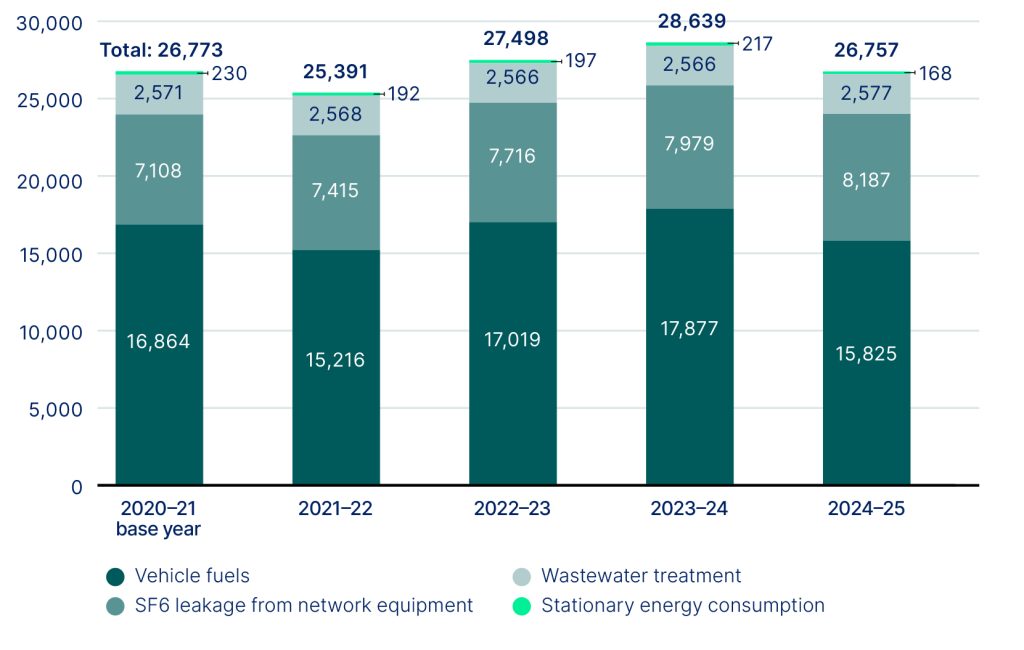
Essential Energy’s Scope 1 emissions are from: vehicle fuels (59% in 2024–25); Sulphur Hexafluoride (SF6) leakage from electricity network equipment (31%); Essential Water’s wastewater treatment (10%); and stationary energy combustion (<1%). See figure 5.
Vehicle fuel emissions decreased by 11% in 2024–25 compared to the previous year, due to a range of actions. The number of electric and hybrid vehicles in the fleet continued to increase, with EVs travelling more than 284,000km during the year. More than 470 light vehicles were replaced with new more efficient vehicles over the past two years. Additionally, a state-of-the-art and award-winning In‑Vehicle Monitoring System (IVMS), installed in fleet vehicles, enables the tracking and improvement of driver behaviour, with resulting efficiency and safety improvements.
SF6 is commonly used in electricity network equipment, such as circuit breakers and switchgear, due to its effectiveness for electrical insulation and arc-quenching. Over time, SF6 can leak from equipment and has a Global Warming Potential (GWP) 23,500 times greater than carbon dioxide. Manufacturers of high voltage electricity network equipment are developing SF6- free alternatives, which Essential Energy is starting to use as alternatives become available. For example, in June 2025, 18 Siemens 132kV SF6-free circuit breakers were procured for use on the network – using vacuum interrupters and clean air insulation instead of SF6.
Total Scope 1 emissions for 2020–21 to 2023–24 are approximately 1,000 to 2,000 tCO2-e higher per year in figures 5 and 6 and table A11 (see ‘Appendices’, Annual Report 2024-25 PDF, page 140) compared to the totals reported in the 2023–24 Annual Report. This is due to a recalculation of SF6 leakage emissions, following data system improvements during 2024–25, which resulted in a better understanding of the amount of SF6 on the network. Work to improve data quality across all emissions sources will continue during 2025–26.
Scope 1 emissions include emissions from Essential Energy, Essential Water and Intium.
FIGURE 5. Scope 1 GHG emissions by category (tCO2-e)
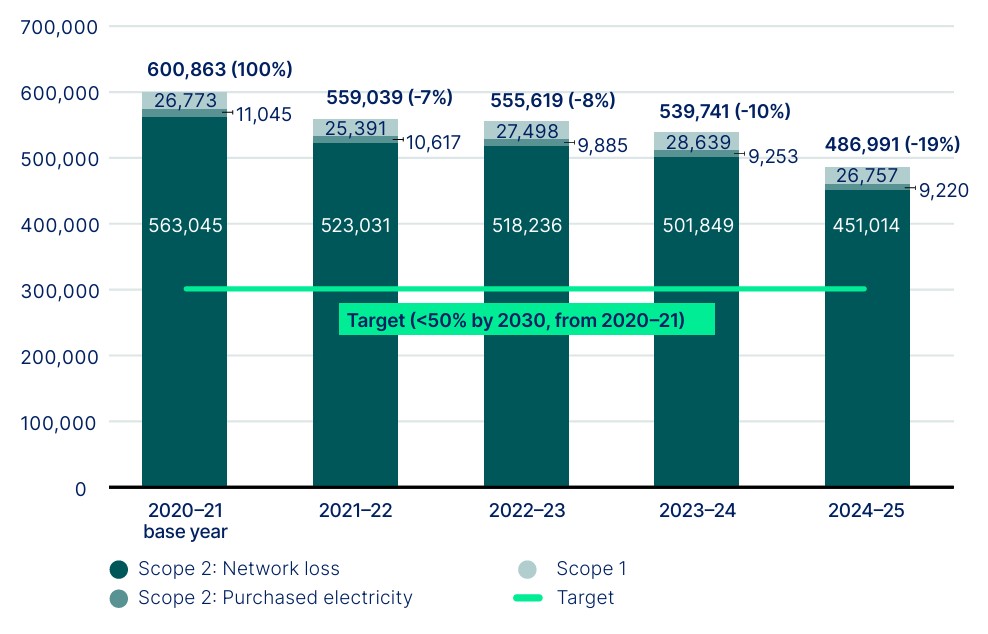
Scope 2 emissions dominate Essential Energy’s total emissions (95% of combined Scope 1 and 2 emissions in 2024–25), particularly emissions that are due to loss of electricity from the distribution network (see figure 6). As electricity moves through the network, some is lost due to electrical resistance and the heating of powerlines and other equipment. With more than 183,000km of overhead powerlines, network losses are underpinned by the significant distances over which electricity is distributed across the regional, rural and remote network area. In 2024–25, 93% of Essential Energy’s combined Scope 1 and 2 emissions were due to distribution network loss.
In 2024–25, network loss emissions decreased by more than 10%, compared to the previous year. This was due to the continuing growth of renewable generation, both as a proportion of total National Electricity Market (NEM) generation and generation from systems connected to the Essential Energy network. Emissions are only attributable to network loss if the generation source creates emissions, from fossil fuel generation. As renewable generation increases, emissions due to network loss decrease. Additionally, with more renewable generation systems connecting to Essential Energy’s network, losses are decreasing due to the shorter distances electricity needs to travel from generation to customers. See ‘Growth in renewable generation connections to the Essential Energy network’, for more information.
Emissions from network losses apply to Essential Energy only, as they relate to the management of the distribution network.
Other Scope 2 emissions are from purchased electricity for Essential Energy, Essential Water and Intium buildings, sites and EVs. These have decreased by 17% over the past five years.
Scope 1 and 2 emissions target
Essential Energy’s target is to reduce combined absolute gross Scope 1 and 2 emissions by 50% by 2030, compared to 2020–21. It was set by the Board in 2022–23. The target was informed by electricity grid decarbonisation modelling through to 2050, with advice provided by external sustainability experts. It contributes to the NSW Government’s whole-of-government target to reduce Scope 1 and 2 emissions by 50% by 2030.
The target is forecast to be achieved primarily through reduced emissions from distribution network loss, due to growth in renewable generation, in the NEM and in systems connected to Essential Energy’s network. Transitioning Essential Energy’s fleet to EVs will also contribute, as will installing solar panels on depots. Work is also being done to reduce the use of SF6 on the network. As of 2024–25, combined gross Scope 1 and 2 emissions reduced by 19% compared 2020–21.
Progress toward the target is monitored by the Board, and the Board Audit and SHRE committees, annually as part of review and approval of climate-related financial disclosures. A possible update to the target will be considered during 2025–26 as part of work to develop a transition plan, including setting a net zero target.
The target applies to the regulated business only (Essential Energy and Essential Water), as it was set before Intium commenced operations.
Essential Energy does not currently use carbon offsets nor removals and does not plan to use these to help achieve the 2030 target.
Additional details for Scope 1 and 2 emissions, including emissions for individual source categories, as well as measurement approaches, inputs and assumptions, are in tables A10 and A11 in Appendices (see tables A10 and A11 in ‘Appendices’, Annual Report 2024-25 PDF, page 138 to 140).
FIGURE 6. Scope 1 and 2 GHG emissions (tCO2-e)
Scope 3 greenhouse gas emissions
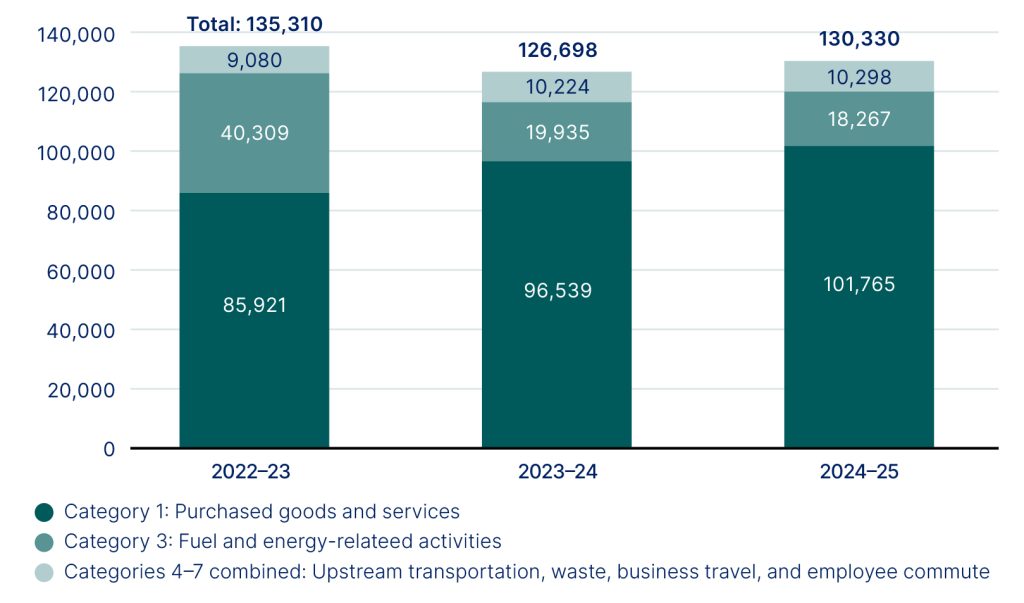
Essential Energy’s Scope 3 emissions are primarily due to Category 1: emissions from purchased goods and services (78% in 2024–25), followed by Category 3: fuel and energy-related activities (14%). Remaining emissions are from Categories 4 to 7 (upstream transportation and distribution, waste generated in operations, business travel, and employee commute) (8% combined). See figure 7.
Initiatives to improve Scope 3 data quality are being implemented. In 2024–25, a waste data review was undertaken, improving the data quality for 2021–22 to 2024–25. See ‘Circular economy and waste management’ for details. As a result, emissions due to ‘Category 5: waste generated in operations’ are restated for 2022–23 and 2023–24 in table A12 (see ‘Appendices’, Annual Report 2024-25 PDF , page 141), compared to the emissions included in the 2023–24 Annual Report.
Emissions from the purchase of capital goods are included in Category 1, rather than separately as Category 2. Categories 8 to 15 are not applicable to Essential Energy. NSW Government entities are not required to include Scope 3 emissions in 2024–25 climate disclosures.
Essential Energy’s Scope 3 emissions are included in this disclosure to continue voluntary reporting, which started in the 2022–23 disclosure. The information included aligns with the Scope 3 requirements within AASB S2.
Additional details for Scope 3 emissions, including emissions for individual source categories, as well as measurement approaches, inputs and assumptions are in tables A12 and A13 in Appendices (see ‘Appendices’, Annual Report 2024-25 PDF, page 141 and 142).
FIGURE 7. Scope 3 GHG emissions by category (tCO2-e)1
Other climate-related metrics and targets
Due to the importance of climate-related risks and opportunities to Essential Energy’s Corporate and Sustainability strategies, additional metrics and targets have been defined. These are aligned to the three ‘Responding to climate change’ commitments within the Sustainability Strategy: Facilitating the net zero transition; Building climate resilience; and Decarbonising our operations. Specific metrics and targets, along with progress since 2021–22 and measurement approaches, are listed in tables A14 to A19 in Appendices (see ‘Appendices’, Annual Report 2024-25 PDF, page 143 to 146).
Progress from 2024–25 includes:
- The target for the number of Essential Energy Battery Energy Storage Systems (BESS) connected to the Essential Energy network – 29 connections by 2029-30 – was reached during 2024–25. As of 30 June 2025, 40 BESS were connected. A new target will be considered during 2025–26.
- The target for the number of GW of renewable energy generation connected to the Essential Energy network – 4.2GW by 2029–30 – is on track to be met. As of 30 June 2025, 3.83GW were connected, an increase of 49% since 2021–22.
- The target for the number of SAPS projects commenced is under review as updated quantitative modelling has reduced the number of locations for which SAPS are an economic and practical alternative to electricity supply via the distribution network. The original target, set in 2021–22, was 400 SAPS by 2028–29.
- The target of the number of EVs in the fleet is also under review, due to vehicle availability challenges, particularly for EVs that meet Essential Energy’s operational needs, as well as slower than expected development of charging infrastructure across regional NSW. The original target, set in 2021–22, was 850 light vehicles and 104 heavy vehicles moved to EVs by 2028–29.
- The number of Major Event Days (MEDs) – tracking only – increased to 17 in 2024– 25, from two in the previous year. MEDs are days when electricity network system stresses are beyond normal operating conditions, due to events such as extreme weather. This was due to the large number of extreme weather events that impacted the network during 2024–25.
The original set of additional metrics and targets was approved by the Board in 2021– 22. The complete set and any adjustments are reviewed and approved by the Board annually.
The other metrics and targets for ‘Facilitating the net zero transition’ and ‘Building climate resilience’ apply to Essential Energy operations only. They do not apply to Essential Water as they are energy related. They do not apply to Intium as they are related to management of the distribution network.
The other metrics and targets for ‘Decarbonising our operations’ are for the regulated business only (Essential Energy and Essential Water); they do not apply to Intium.
Metrics and targets specifically for Essential Water and Intium are yet to be defined.