
Risk management
Essential Energy’s processes to identify, assess, prioritise and monitor climate-related risks and opportunities have matured over recent years, with key activities including:
- Business-as-usual risk management processes for physical climate-related risks, including for network planning, asset inspection and maintenance, vegetation management, bushfire preparations, and fault and emergency response (see ‘Our operations’). These have been in place for many years and are managed via enterprise risk management processes.
- Climate Impact Assessment for physical risks, which quantified the nature, likelihood and magnitude of bushfires, floods and windstorms, and was completed by external specialists during 2021–22. The assessment has informed network resilience planning (see ‘Case study: Mitigating physical risks‘).
- Corporate Strategy development and review – pillars one to four of the Corporate Strategy were developed in 2021–22, following an extensive review by the ELT and Board of the external landscape, technological possibilities, economic trends, and enabling NSW policy. Pillar five was added in 2023–24, recognising the importance of the digital transition to the broader energy transition. Factors informing the Corporate Strategy are reviewed by the ELT and Board every three months.
- Sustainability double materiality assessment, undertaken during 2023–24 – to determine the sustainability-related topics most likely to impact the business and stakeholders, including climate-related risks and opportunities.
- Annual disclosure of risks and opportunities in climate disclosures since 2021–22 – with these risks and opportunities descriptions being developed by relevant internal subject experts (from Corporate Strategy, Risk Management and Compliance, Asset Management and Regulatory Strategy, Finance and Sustainability) and reviewed and approved by the ELT, Board Audit Committee and Board.
The risks and opportunities in this disclosure (table 2) are a refinement of those included in the 2023–24 disclosure. Key refinement activities included:
- Transition risks and opportunities workshop – to identify and describe Essential Energy’s most significant transition risks and opportunities. This involved internal subject experts from Corporate Strategy, Risk Management and Compliance, and Sustainability. A range of risk factors were considered, including: policy and legal, technology, markets, and reputation. A range of opportunity factors were also considered, including: resource efficiency, energy sources, products and services, markets, and resilience. The identified risks and opportunities were then reviewed by the CWG.
- More detailed assessment of transition risks and opportunities – considering the nature of these risks and opportunities, likelihood and materiality informed by Essential Energy’s enterprise risk matrix, and including current and anticipated responses. This was undertaken by the Sustainability team and reviewed by the CWG.
- Review and approval of these risks and opportunities by the ELT, and then by the Board Audit Committee and Board (as part of reviewing and approving this disclosure).
Physical risks were not considered for refinement in the workshop as the two identified risks have been well understood as material risks for Essential Energy for many years. They were however reviewed and approved by the CWG, ELT and Board Audit Committee and Board as part of reviewing and approving this disclosure.
Climate-related physical risks and transition risks and opportunities are prioritised as part of business-as-usual strategic and financial planning. An example is the shift from timber to composite materials for power poles, to reduce the risk of bushfires impacting the network.
Climate-related risks and opportunities are monitored by the ELT and Board through six-monthly monitoring of the factors underpinning the Corporate Strategy, quarterly sustainability updates, annual review of sustainability metrics and targets in the Sustainability Strategy (see tables A14, A16 and A18 in ‘Appendices’, Annual Report 2024-25 PDF, page 143 to 146), and annual reviews of enterprise risks.
Essential Energy’s overall approach to managing enterprise risks includes a Risk Management Board Governance Policy, Risk Management Company Procedure, and Corporate Risk Matrix. A risk management data system is also in place, to capture information about enterprise risks. This approach supports enterprise risk oversight by the Board, as well as risk management by the ELT and business areas responsible for risks.
During 2024–25, climate-related risks were cross-referenced with enterprise risks. Many climate risks are escalation factors for existing enterprise risks. For example, bushfires is an existing enterprise risk and climate change will increase the likelihood of bushfires as well as the severity of impacts. Investigations into how best to incorporate climate-related risks into the risk management data system also commenced. Plans are in place for 2025–26 to improve the integration of climate-related risks and opportunities into existing approaches for enterprise risks and opportunities.
Case study
Mitigating physical risks
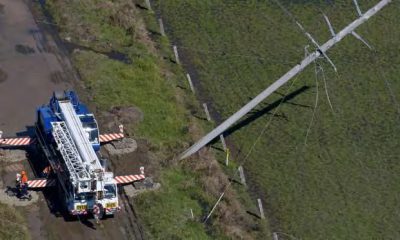
A Climate Impact Assessment, undertaken by external risk modelling experts during 2021–22, quantified financial and non-financial impacts of physical climate events (bushfires, floods and windstorms) on Essential Energy’s network assets. Future climate scenarios were considered, using Intergovernmental Panel on Climate Change emission trajectories Representative Concentration Pathways 4.5 and 8.5 over the time horizons of 2050, 2070 and 2090. Integration of modelling outcomes into asset management systems commenced during 2023–24, to inform ongoing long-term planning. The modelling was also extended to include property assets during 2023–24.
This modelling informed the 2024–29 Regulatory Proposal, resulting in approval by the AER of $205 million for network resilience initiatives over the 2024–29 period. Initiatives included: installation of composite poles in areas with a high bushfire risk; installation of SAPS and microgrids; relocating the Lismore depot and substation away from flood-prone land; and laying selected powerlines underground in high-risk bushfire and windstorm areas.
This is a good example of climate-related risk analysis influencing business strategy, decision making, funding and resource allocation to mitigate physical climate risks.