
Sustainability strategy
The Essential Energy Sustainability Strategy has three pillars, reflecting a holistic approach to sustainability:
- Responding to climate change
- Empowering our people
- Enabling regional development and resilient communities.
The strategy guides the approach to generating positive value for customers and communities, our people and the environment. It builds on the Corporate Strategy and operational strategies, highlighting the sustainability priorities important to Essential Energy and our stakeholders.
Essential Energy is committed to supporting the transition to a net zero economy while continuing to focus on the safety and wellbeing of workers and communities, as well as championing an inclusive, supportive and growth-oriented culture. We contribute to regional communities through our partnerships, advocacy, engagement and tech-enabled solutions.
Pillar 1: Responding to climate change
Pillar 1 commitments:
- Facilitating the net zero transition – by supporting electrification, including electric vehicle (EV) penetration and scaling and optimising renewable generation connections to the electricity network.
- Building climate resilience and partnering to minimise disruptions during crises – by future-proofing assets, providing customers with alternate energy solutions and responding to climate events.
- Decarbonising our operations – by electrifying our fleet, leveraging renewables and actively managing distribution network losses in the way we build, operate and maintain the network.
Climate-related risks and opportunities that are material to Essential Energy are detailed in the ‘Climate-related financial disclosure’, along with governance approaches, business responses, risk and opportunity management processes, and associated metrics and targets. This includes details of Essential Energy’s greenhouse gas emissions.
The Corporate Strategy drives our efforts to respond to climate change and progress the energy transition, with significant progress made over the past year.
Business-as-usual programs also contribute to building climate resilience and partnering to minimise disruptions during crises, particularly ongoing bushfire mitigation activities. See ‘Bushfire preparation’.
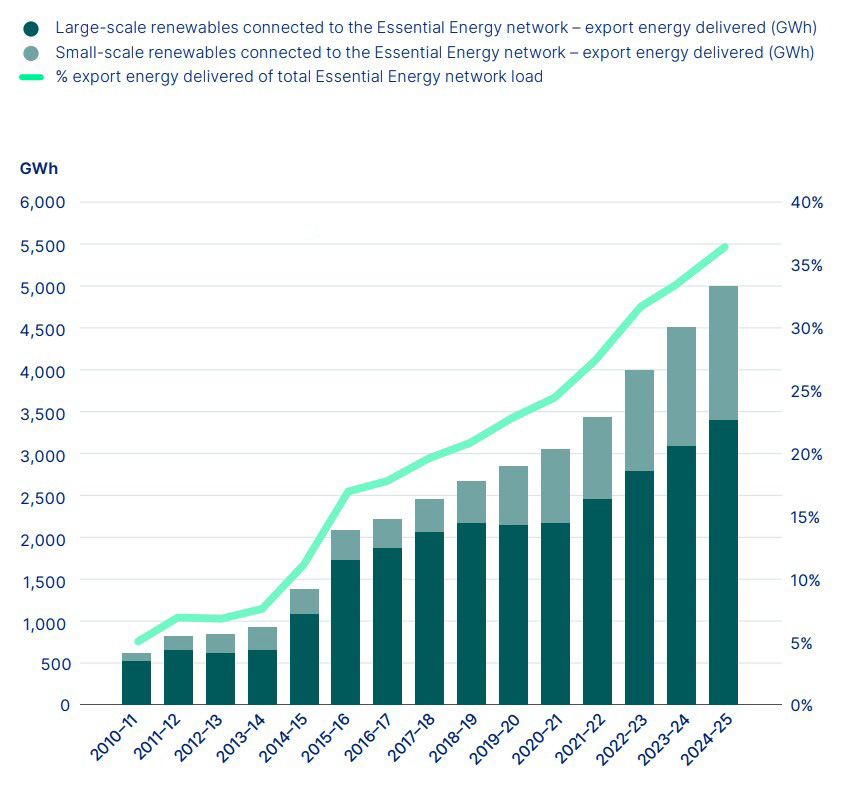
Progress facilitating the net zero transition is demonstrated by continuing growth in renewable generation connections to the Essential Energy network. During the year, 13 new large-scale1 facilities were connected, along with more than 14,000 new smallscale systems (mostly rooftop solar). Total capacity was 1.56GW for connected largescale renewables and 2.28GW for small-scale renewables, at 30 June 2025. Renewable generation connected to the Essential Energy network delivered 36.6% of the network load, building on more than a decade of continued growth.
Essential Energy continues to decarbonise its operations and reduce its environmental impact. Pathways for transitioning away from using sulphur hexafluoride (SF6) gas in our network infrastructure continue to be investigated. SF6 is a very potent greenhouse gas widely used in electricity assets for insulation and arc-quenching. Progress during the year included ordering 18 Siemens 132kV SF6-free circuit breakers, for installation across our network – using vacuum interrupters and clean air insulation instead of SF6.
Growth in renewable generation connections to the Essential Energy network
LARGE-SCALE CONNECTIONS (AS AT 30 JUNE 2025):
-
69
total connections – 13 new connections in 2024–251
-
1.56 GW
total capacity – 4.0% increase in 2024–252
-
3,397 GWh
delivered – 9.9% increase since 2024-25
-
24.9 %
energy delivered of total Essential Energy network load – 1.8% increase in 2024-25
SMALL-SCALE CONNECTIONS (AS AT 30 JUNE 2025)
-
307,005
total connections – 4.9% increase in 2024-25
-
34.0 %
total customers – 1.4% increase in 2024–25
-
2.28 GW
total capacity – 9.6% increase in 2024-25
-
1,595 GWh
delivered – 12.6% increase in 2024-25
-
11.7 %
energy delivered of total Essential Energy network load – 1.1% increase in 2024-25
FIGURE 2. Growth in export energy delivered to the Essential Energy network from large-scale and small‑scale renewables
Pillar 2: Empowering our people
Pillar 2 commitments:
- Ensuring the safety and wellbeing of employees – through our health and wellbeing program and leading health and safety standards
- Championing an inclusive, supportive and growth-oriented culture – by promoting our values and building a diverse and accountable workplace.
Endeavours to empower our people are guided by our people strategies – for Organisational Safety, Inclusion and Diversity, and Talent Acquisition.
Pillar 3: Enabling regional development and resilient communities
Pillar 3 commitments:
- Assisting regional business and communities – through partnerships, advocacy, engagement and tech-enabled solutions, to provide reliable and efficient connections.
- Ensuring sustainable and resilient supply chains – by responding to social and environmental vulnerabilities in our supply chains and integrating sustainability into our procurement decisions.
- Protecting cultural heritage – through engagement with First Nations groups, guardians and landowners and managing risks in culturally significant areas.
We contribute to regional communities through our partnerships, advocacy, engagement and tech-enabled solutions.
We assist regional business and communities by implementing the Corporate Strategy, with all initiatives focused on delivering benefits to regional customers and communities. See ‘Strategy’ for details. Providing safe and reliable power to customers and communities is key, with 2024–25 activities and performance detailed in ‘Our operations’. The Customer Strategy underpins the service we provide, with performance described in ‘Our customers’.
We also provide financial support for community organisations and charities across our network area. We gave more than $867,000 to community groups, stakeholders and charity organisations during the year – combined contributions from Essential Energy and our generous employees. See ‘Supporting community organisations and charities’ for more information.
Our efforts to ensure sustainable and resilient supply chains are guided by the Procurement Sustainability Strategy. Under this strategy, sustainability requirements are applied to all sourcing activities worth more than $500,000. These requirements were refreshed during the year, increasing the number of available questions for suppliers from five to 18, across economic, environmental and social sustainability – to support more informed decision making.
We also procured $4.42 million worth of goods and services from registered Aboriginal and Torres Strait Islander enterprises during the year. See ‘Reconciliation’ for more information.
Essential Energy’s 2024–25 Modern Slavery Statement is a key report for sustainable and resilient supply chains, and will be released in December 2025. Highlights from the year include:
- 95.9% of addressable expenditure was with suppliers who have completed the Modern Slavery Supplier Assurance qualification, successfully meeting our target of 95%.
- Conducting a deep dive into the global supply chains for solar panels. This will inform future procurement decisions, targeted supplier engagement, and traceability efforts so that our work to facilitate the energy transition does not compromise human rights.
- Reviewing the effectiveness of our grievance mechanism to confirm alignment with United Nations Guiding Principles on Business and Human Rights.
The important work of protecting cultural heritage by engaging with First Nations groups continued during the year, with key activities outlined in ‘Reconciliation’.