
Governance
Governance bodies
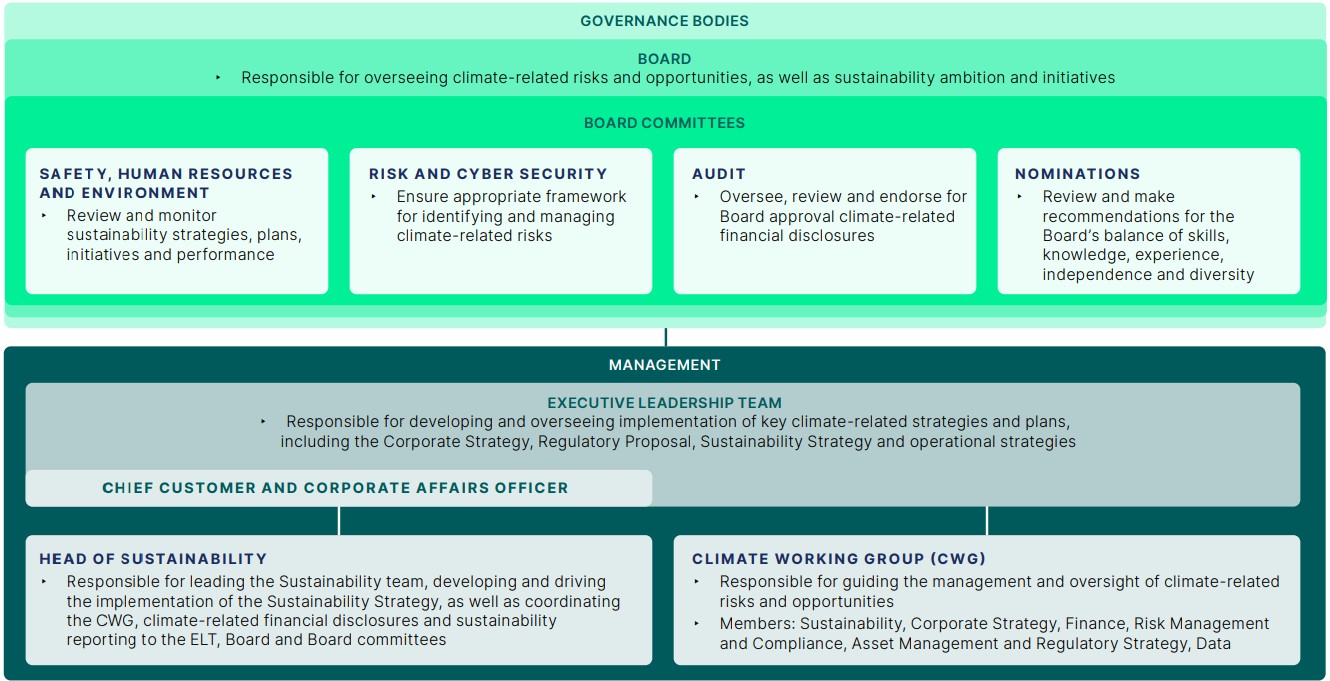
The Board (see ‘Board of Directors’, Annual Report 2024-25 PDF, page 68 to 71) is responsible for overseeing climate-related risks and opportunities, as well as sustainability ambition and initiatives. It is also responsible for considering, approving and monitoring the progress and performance of the Sustainability Strategy, including in relation to climate change.
Some oversight responsibilities are delegated to Board sub-committees:
- Safety, Human Resources and Environment Committee: review the effectiveness of sustainability strategies, plans and initiatives and monitor sustainability performance – via quarterly Sustainability Strategy updates, which are also provided to the Board.
- Risk and Cyber Security Committee: ensure an appropriate framework for identifying and managing risks arising from climate change (including physical and transition risks), and monitor strategic and business risks, including climate change and other sustainability and environmental risks.
- Audit Committee: oversee, review and endorse for Board approval annual climate-related financial disclosures.
- Nominations Committee: review and make recommendations in relation to the Board’s balance of skills, knowledge, experience, independence and diversity – including via an annual review of the Board’s skills matrix.
These Board and Board sub-committee responsibilities are documented in the Board and Board Committee Charters.
Essential Energy’s responsibility to provide safe and reliable electricity supply, combined with the strategic objective to facilitate the net zero transition, mean climate-related risks and opportunities are central to the sustainability of the business. As such, response approaches and initiatives are core to the Corporate Strategy, Regulatory Proposal, Sustainability Strategy and operational strategies and plans – including for bushfire prevention and vegetation management.
The Corporate Strategy is approved by the Board and addresses multiple climate-related transition opportunities, including supporting the uptake of renewable energy solutions, facilitating electric vehicle (EV) adoption, and enabling smart energy solutions for regional communities. External factors relevant to the Corporate Strategy are monitored and reviewed by the Board every six months.
Essential Energy’s Regulatory Proposal is reviewed and approved by the Board every five years, with proposals containing plans, initiatives and funding for the five-year regulatory period for submission to the economic regulator, the Australian Energy Regulator (AER). The AER’s determination for the 2024–29 period contained $205 million approved funding for network and community resilience initiatives, in response to climate change.
Climate-related physical risks and transition risks and opportunities arising from regulation, policy, market activity or technology advancements are also considered and addressed by the Board as part of business-as-usual strategic and financial planning. This includes considering trade-offs associated with climate-related risks and opportunities. For example, during 2024–25 the Board approved a Bushfire Priority Zone Transition plan, which was informed by bushfire risk modelling and balances effective and efficient allocation of vegetation management resources. The plan will reduce the bushfire risk in newly identified high priority areas and is expected to take eight years to complete.
The current Sustainability Strategy was approved by the Board in 2021–22. It includes the ‘Responding to climate change’ strategic pillar and three commitments: Building climate resilience; Facilitating the net zero transition; and Decarbonising our operations. This pillar remains relevant and will be updated when significant changes are required. Climate-related and other sustainability metrics and targets were set by the Board after the Sustainability Strategy was approved. Metrics and targets were established by working with subject matter experts and in consultation with the Sustainability Working Group and Executive Leadership Team (ELT). They are reviewed, approved and monitored by the Board annually. See ‘Metrics and targets’ for more information.
The full list and description of material climate-related risks and opportunities are reviewed and approved by the Audit Committee and Board annually, as part of the climate disclosure approval process.
The Board continues to increase its understanding of the implications of climate-related risks and opportunities faced by Essential Energy via the reporting to subcommittees noted above, as well as specific strategic education sessions. During March 2025, a sustainability-focused Board strategy workshop included an education session on the evolution of sustainability reporting and Board responsibilities. These education activities position the Board to continue steering the organisation’s preparations for and responses to climate- and sustainability-related risks and opportunities.
FIGURE 4. Governance structure for overseeing and managing climate-related risks and opportunities
Management
The Executive Leadership Team (ELT) (see ‘Executive Leadership Team’, Annual Report 2024-25 PDF, page 72 to 73) is the highest decision-making body within the management structure, and is responsible for developing and overseeing implementation of key climate-related strategies and plans, including the Corporate Strategy, Regulatory Proposal, Sustainability Strategy and operational strategies.
Like the Board, the ELT monitors and reviews external factors relevant to the Corporate Strategy every six months, considers climate-related risks and opportunities as part of business-as-usual strategic and financial planning for operational strategies, and reviews and endorses the Regulatory Proposal every five years. The ELT reviews progress for and performance against the Sustainability Strategy via quarterly updates.
The Climate Working Group (CWG) is responsible for providing effective guidance for the management and oversight of climate-related risks and opportunities, within the context of the Sustainability Strategy. This includes ensuring compliance with climate-related reporting obligations. Members include representatives from Corporate Strategy, Finance, Risk Management and Compliance, Asset Management and Regulatory Strategy, Data, and Sustainability. The group implemented monthly meetings from January 2025, having met approximately quarterly following formation in late 2023–24. The group reports to the ELT.
The Head of Sustainability reports to the Chief Customer and Corporate Affairs Officer, and is responsible for leading the Sustainability team and developing the Sustainability Strategy and associated initiatives, including the ‘Responding to climate change’ pillar, as well as driving implementation and monitoring progress. The role also coordinates the CWG and sustainability reporting to the ELT and Board, and manages the compilation of climate-related financial disclosures.
Controls and procedures used by Management to support the oversight of climate-related risks and opportunities, as well as integration with other internal functions, include:
- regular Corporate Strategy and Sustainability Strategy updates to the ELT (as detailed above)
- a sustainability section in the template for ELT and Board papers that seeks information on how the paper is aligned to the Sustainability Strategy and climate-related financial disclosure requirements
- cross-functional representation in the CWG.
Essential Energy’s climate-related risks and opportunities overlap with enterprise risks and opportunities. For example, climate change is an escalation factor for the physical risk of bushfires. Also, energy transition opportunities are key to the Corporate Strategy. Work to integrate climate-related risks and opportunities with processes for managing enterprise risks and opportunities commenced during 2024–25 and is planned to continue during 2025–26. This will assist Management and the Board to manage and oversee climate-related risks and opportunities in a more holistic and integrated way.
For all procurement activities worth more than $500,000, vendors are required to address a set of sustainability requirements. These include actions in response to climate change, as well as broader economic, environmental and social sustainability considerations – to support more informed procurement decision making.